Pitch decks, financial models and due diligence reports are the grunt work that fills a junior banker's week. A London startup just raised $250 million to hand much of that work to AI agents, and investors valued it at $1.5 billion.
The deal
Model ML raised $250 million in a Series B round at a $1.5 billion valuation, co-led by General Atlantic and QED Investors, according to DailySynapse. The round brings the London startup's total raised to $350 million, per the same report. Global Horizon Daily says the round follows a $75 million Series A announced about a year earlier. Law firm Dentons confirmed that it advised investors Evolution Equity Partners and Forestay Capital on their participation in the $250 million Series B, which valued the company at $1.5 billion, per Dentons.
Reports differ a little on timing. DailySynapse is dated November 21, while Dentons on November 24 calls the round "recently announced." We treat it as announced in the past week.
What it builds
Model ML builds agents for bankers, consultants and investors that run on customers' own systems and data, per DailySynapse. The agents assess relevant company news, prepare analysis in each firm's preferred format and work in Excel and PowerPoint to produce pitch decks and due diligence reports, according to DailySynapse. The company routes tasks to suitable AI models, with a growing share handled by its own fine-tuned open-source models, per DailySynapse. It also says customer data is never used to train AI models, per DailySynapse.
Why bankers are the target
Investment banking is a good fit for this pitch because so much of the work is document-heavy and repeatable. Analysts spend long hours pulling numbers into spreadsheets, formatting slides and checking details before a client meeting. An agent that works inside Excel and PowerPoint, on a firm's own data, goes straight at that time. The reports do not say how much of a deck the agents finish without a human check, and we would not assume it is all of it. Banks also face strict rules on client data, which is why the company stresses that customer data is not used to train models, per DailySynapse.
The numbers are the company's own
Model ML says its annual recurring revenue grew 12 times year on year in the third quarter, and daily active users rose 26 times, per DailySynapse. For tasks handled by its own models, it says they cost 2% as much as frontier models and are generally five times faster, per DailySynapse. These are claims from the company. We have not seen audited figures, and the reports do not give absolute revenue.
Revenue is split fairly evenly among banks, consulting firms and asset managers, per DailySynapse. Competitors include Rogo, OpenAI and Anthropic, according to the same report.
The founders
Global Horizon Daily says Model ML was founded about three years ago by brothers Chaz and Arnie Englander, who previously co-founded two other companies. One of them, the peer-to-peer rental marketplace Fat Llama, was acquired by Sweden's Hygglo for $41.5 million in 2022, per Global Horizon Daily. CEO Chaz Englander described the agents as revenue-generating tools, not only a way to improve efficiency or cut costs, according to DailySynapse. The funding will support research and engineering expansion in London and New York, per DailySynapse.
What to watch next
Watch whether Model ML publishes customer names and hard revenue numbers. Also watch how OpenAI and Anthropic move into the same finance workflows, since both are named as competitors. And watch how banks respond: the reports say nothing about job cuts, so any claim about replacing junior bankers is an inference, not a reported fact.
Why it matters
The "AI replaces entry-level white-collar work" argument usually stays abstract. This is a concrete example with money behind it: a startup selling agents that produce the same documents juniors produce, and investors paying a $1.5 billion price tag for the idea. It does not prove those jobs disappear. It shows where investors think the next wave of AI revenue is. Treat the growth numbers with care until they can be checked.
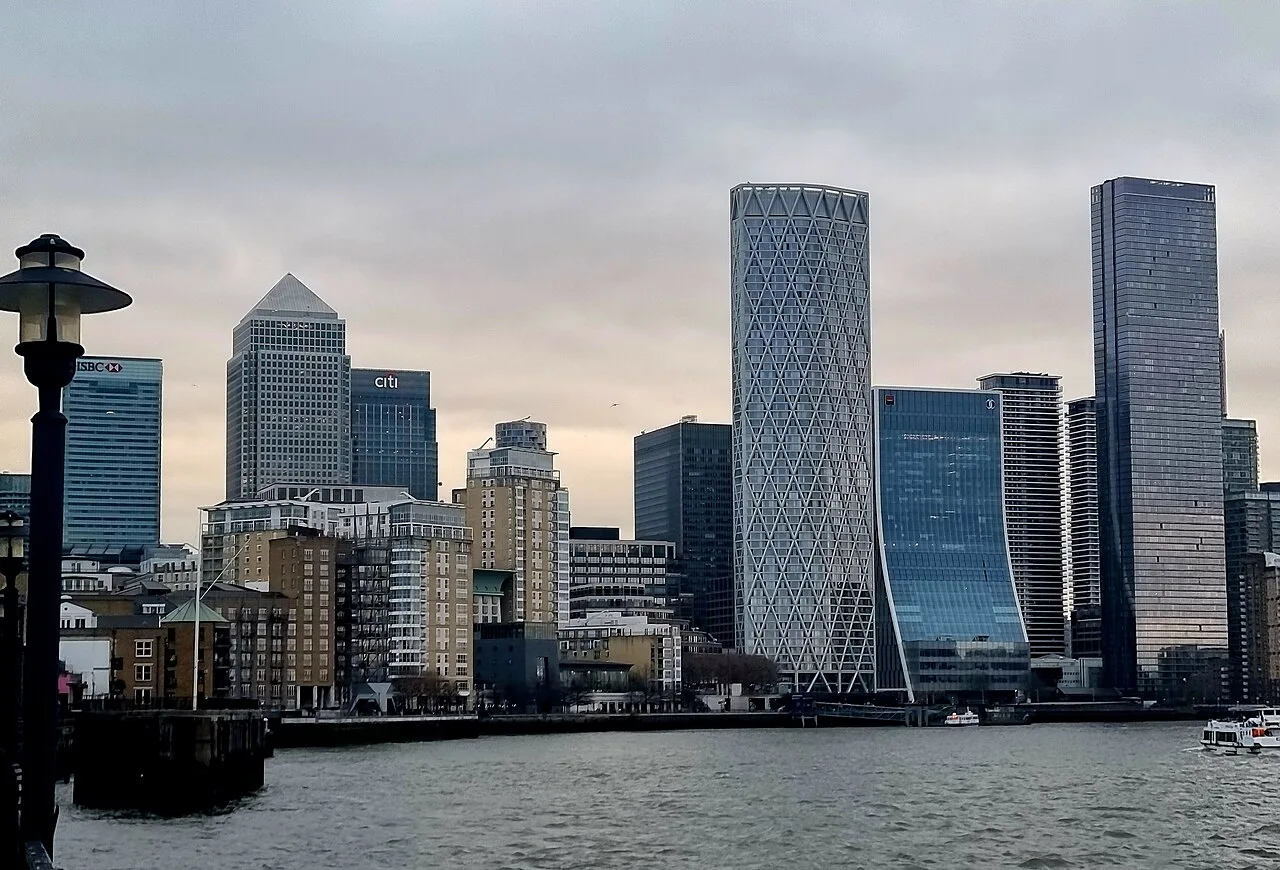
Cover image: Canary Wharf Reza 01 by M R Karim Reza, CC BY-SA 4.0, via Wikimedia Commons. Illustrative photo of London's Canary Wharf financial district, not a photo of Model ML.